
Content craft
Social Media Hooks: 20 Examples for Posts, Reels and Video
How to write social media hooks for captions, carousels, Reels, TikTok, YouTube Shorts, email and podcasts: 20 techniques with written and video examples, and a way to test them.
Published 24 min read
Most content does not fail because the idea was bad. It fails because nobody was given a clear reason to stop, swipe, click or keep watching.
That reason is the hook.
A hook can be the headline on a static image, the first line of a caption, the opening slide of a carousel, the subject line of an email, the first sound in a podcast, or the first few seconds of a video. Whatever the format, it does one job: it tells the right person that this is for them, and that something worth knowing is about to happen.
What a hook actually is
The definition that matters
A hook is the opening element that gives someone a reason to keep going. Depending on the format, that is:
- The headline on a static graphic
- The first line of a caption or a LinkedIn post
- The first slide of a carousel
- The title and opening paragraph of an article
- The subject line and preheader of an email
- The episode title or cold open of a podcast
- The first frame, spoken line, text overlay or sound in a video
A good hook sets a clear expectation. It signals a problem, a result, a story, a conflict, a question or a useful discovery that the content is about to resolve. A bad hook wins attention and then fails to deliver on it. That is clickbait, and it costs more than it earns.
A hook is not a topic
This is the single most common confusion, and fixing it improves most people’s openings immediately.
Topic
Content planning tips
Hook
Your content calendar is not the reason you keep missing deadlines
Topic
Skincare routine
Hook
Your moisturiser may be working against the rest of your routine
Topic
Small business bookkeeping
Hook
The expense most new business owners forget to record
The topic tells people what the content is about. The hook tells them why it is worth their attention right now.
Written and video hooks work differently
Written content usually has one dominant opening element: a headline, a first sentence, or a first slide. If it fails, nothing else gets read.
Video can hook through four channels at the same time, and they either reinforce each other or fight:
- Visual hook: what is in the first frame before anyone has spoken
- Verbal hook: what the first spoken line says
- Text hook: what viewers read on screen
- Audio hook: the sound, voice, music or deliberate silence
There is a fifth channel that is easy to forget: motion. A static opening frame and a frame where something is already happening carry very different amounts of information, even when the content is identical.
The three-layer video hook
For short-form video, the reliable approach is to combine three compatible signals that all point at one idea.
Spoken line
Your content calendar is creating more work than it saves.
On-screen text
Why content calendars quietly fail
Opening visual
A cluttered spreadsheet cuts to a clean weekly approval view.
The viewer understands the topic with or without sound. The spoken line creates the tension, the text supplies clarity, and the visual provides proof. Three layers, one idea.
The failure mode is using three layers for three different ideas:
- A spoken line about saving time
- On-screen text about increasing sales
- A visual showing a design tutorial
That produces confusion, not curiosity. The viewer cannot tell what the video is for, so they leave.
What platforms actually document
A lot of hook advice is presented as platform policy when it is really folklore. It is worth separating the two. TikTok is the platform that publishes the most specific public guidance, and it is written for advertisers rather than organic creators, which is an important caveat.
In its creative best practices for performance ads, TikTok recommends introducing the content proposition in the first three seconds “for better recall and awareness”, and prioritising the hook within the first six seconds “to boost engagement and increase watch time”, which it suggests doing by creating suspense, surprise or other emotions. It also recommends captions or text overlays for context, at roughly five to ten words per second, and a structure of hook, then unique selling points, then a clear call to action. TikTok creative best practices
What this does not mean
It does not mean every organic video has to compress its entire message into one second, and it does not mean a slower opening is always wrong. A three minute explainer for an audience that already trusts you can open differently from a cold-traffic ad.
What it does mean is that the opening should carry real information rather than greetings, logo animations, long introductions or unrelated footage. That principle holds across every platform, whether or not the platform publishes a number for it.
Why some hooks attract the wrong people
A hook does not just decide how many people stop. It decides which people stop. This is the part most hook advice skips, and it is where a lot of well-performing content quietly goes wrong.
An opening built on shock, an unrelated trend or a very broad promise will pull in a large, general audience. If the content is actually a specialist tutorial for one profession, most of those viewers leave, the retention curve collapses after the hook, and the comments are unrelated to the subject.
Attracts everyone
Nobody is talking about this pricing trick
Attracts buyers
If you quote by the hour, this is the one line to change on your next proposal
The second hook will stop fewer people. The people it stops can actually become customers.
A useful habit: before publishing, name the person you want to stop, and name the person you would rather scroll past. If your hook does not filter between them, it is doing half a job.
20 hook techniques, with written and video examples
These are patterns, not scripts. Each one includes the underlying structure, a written example, a video example and the opening visual that would carry it. Six of them include a case study from an account whose original work you can still watch, so you can check the mechanic rather than take my word for it.
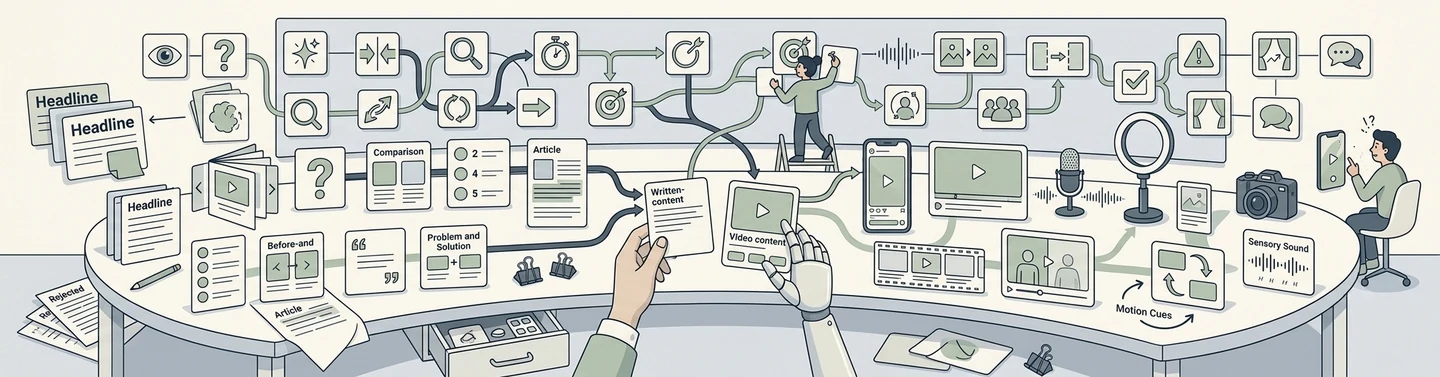
1.The clear outcome
Pattern
Get [specific result] without [the usual cost or frustration].
Outcome hooks work because they name the change the content offers. They fail when the outcome is so broad that nobody can picture it.
A real example
Duolingo / advanced content spot, April 2026
The spot does not open on the app, the mascot or the price. It opens on the outcome the learner actually wants, holding a real conversation, and only then explains that the courses now run to an advanced level. Naming the result before the mechanism is the technique, and it costs nothing to copy.
Written
Plan a full week of client content without opening seven different tools.
Video
Here is how one customer question turned into five posts.
Opening visual
Show the five finished posts first, then explain where they came from.
Weaker
Transform your business today.
Stronger
Cut your Sunday planning session from three hours to one.
2.Problem first
Pattern
If [frustrating situation] keeps happening, [unexpected cause] may be why.
A problem-first hook lets people recognise themselves before you offer anything. It only works if the problem is real and observable. Inventing anxiety to make an ordinary situation sound dangerous is the fastest way to lose the audience you wanted.
Written
Posting consistently but still getting no enquiries? Your content may be answering questions nobody is asking.
Video
If clients keep requesting revisions, the problem probably started before anyone opened the design file.
Opening visual
A comment thread full of revision requests, then a cut to the vague brief that caused them.
3.The curiosity question
Pattern
What happens when [familiar thing] meets [unfamiliar test]?
A question hook opens an information gap the content then closes. The gap has to be specific. A question without a subject creates no curiosity at all.
A real example
Brick Technology / Can a LEGO Man Survive a Car Crash? May 2026
The title is the question, and the first frames set up the test rather than introducing the channel. Each round crashes the car, adds one safety idea, and runs it again, so the gap the question opened stays open while the answer is built in front of you. The format is reusable forever because the question, not the object, is the hook.
Written
What happens when a bakery posts nothing but customer questions for a month?
Video
Can a fifteen dollar desk lamp make product videos look professional?
Opening visual
Show the finished result first, then reveal the cheap setup behind it.
Weaker
Want to know a secret?
Stronger
Why does the same photo look worse on the shop page than on Instagram?
4.The contrarian take
Pattern
Stop doing [widely accepted practice] if [specific condition] applies to you.
A contrarian hook challenges an assumption. It works when the disagreement is defensible and the conditions are stated. It fails when it exists purely to provoke replies.
Written
Your small business probably does not need to post every day.
Video
Stop adding content pillars. You may already have too many.
Opening visual
Delete three overlapping categories from a crowded planning board.
The myth-busting variant
A close relative of the contrarian hook is the myth-buster, which questions what a phrase means rather than what people should do: [common belief] does not mean what people assume it means.
Written
A content calendar is not supposed to predict every post you will publish.
Video
Natural light does not mean standing directly in front of a window.
Name the belief clearly, show precisely what is incomplete about it, then replace it with something more useful. Skipping the third step leaves the audience with nothing.
Weaker
Everything you know about marketing is wrong.
Stronger
Daily posting works for accounts selling impulse purchases. It rarely works for six month sales cycles.
Say “everything you know is wrong” only if your point is actually that large. Usually it is not.
5.The open loop
Pattern
We expected [likely result], but [unexpected development] changed it.
An open loop introduces something unresolved. The audience stays because the story has not reached its explanation yet. The discipline is closing the loop quickly enough that staying felt worthwhile.
Written
We changed one sentence on the first slide. Everything else in the carousel stayed identical.
Video
This product photo looked better before we turned the studio light on.
Opening visual
Show both versions without saying which setup produced which.
The failure mode
Dragging a ten second answer across a three minute video is not suspense, it is a tax on the viewer. An open loop should sustain interest, not punish it. If the payoff is small, close the loop early and spend the remaining time on something else.
6.The specific number
Pattern
We tested, reviewed or changed [specific number] and found [clear result].
Specificity is easier to picture and, when the number is real, more credible than a superlative. The number has to come from a process you can describe.
A real example
Spotify / Wrapped
Wrapped turns a listener’s own minutes, artists and genres into a personal summary they can share. The numbers hold attention because they belong to the person seeing them, not because they are large. That is the transferable idea: a small number about the reader beats a big number about the industry.
Written
We read 42 customer emails. Seven questions appeared in almost every one.
Video
I tested three openings on the same video. This is the one people stayed for.
Opening visual
All three opening frames side by side before any explanation.
If you do not have analytics
You do not need a data team to use this. Count repeated customer questions, note which posts get saved, group the support requests you answer most often, or track which products are bought together. Small honest numbers work. Invented precision such as “17.3 times better” does not.
7.The mistake
Pattern
The [common mistake] that causes [specific consequence].
People will stop to check whether they are making a mistake. The technique fails when the language is disproportionate to the actual stakes, because the correction then feels trivial by comparison.
Written
The carousel mistake that makes slide two feel unrelated to slide one.
Video
This is why your tutorial loses viewers before the tutorial starts.
Opening visual
Play the slow introduction, freeze it, and mark the point where the useful part should have begun.
Weaker
Three mistakes destroying your business
Stronger
Three caption habits that make good posts easy to scroll past
8.Before and after
Pattern
Before [change] against after [change], for [specific situation].
Contrast communicates transformation faster than any description of it. This covers both the before and after hook and its sibling, the direct comparison of two options.
Written
Before: “Check out our new menu.” After: “The lunch special our regulars kept asking us to bring back.”
Video
The same product filmed with and without a background light.
Opening visual
Start on the split screen. Do not spend five seconds building up to the comparison.
Keep the variables honest
If the lighting, camera, angle and editing all changed, you cannot attribute the result to one of them. Comparisons that quietly move several variables at once are the most common way this hook misleads people, usually without meaning to.
9.The live demonstration
Pattern
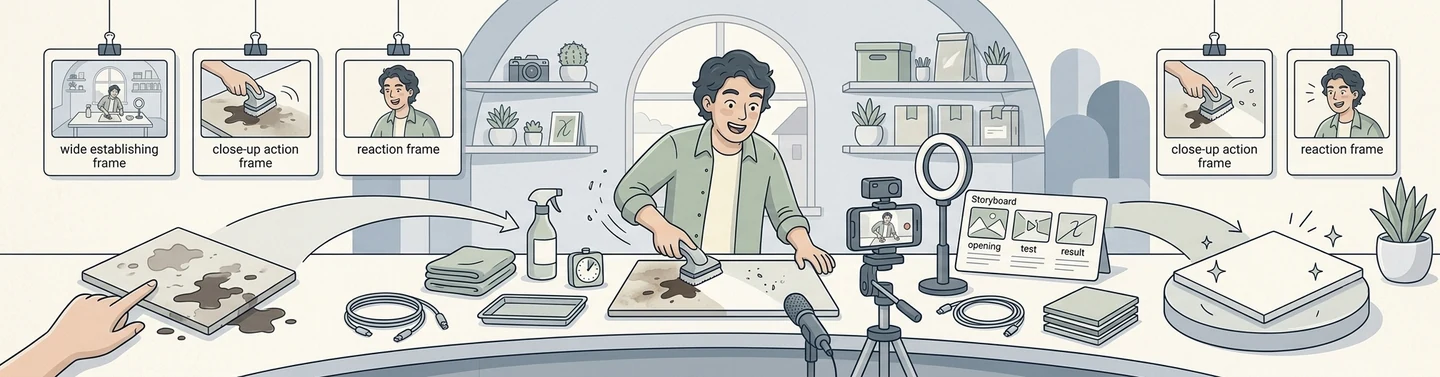
Watch [product, technique or claim] handle [a genuinely difficult test].
A demonstration hook puts the claim under pressure in front of the viewer. The test has to be connected to what the thing is actually for.
A real example
Apple / iPhone 17 scratch resistance, January 2026
Thirty six seconds, one claim, and the claim is under test from the opening frame. Nothing is asserted that the footage does not show happening. The transferable part is not the production budget, it is the discipline of choosing a test that would visibly fail if the product were not as good as the claim.
Written
We gave the same brief to a designer, a copywriter and a client. Here is what each of them understood.
Video
Can this remover handle coffee that has been sitting overnight?
Opening visual
The stain, already there, with the product entering the frame.
Weaker
A dramatic stunt viewers remember while forgetting what was being sold
Stronger
A test that fails visibly if the product does not work
10.Visual proof first
Pattern
Show the evidence before making the claim.
When the proof is visually obvious, the words can be simpler. This is the hook for anything where the result is visible: physical products, design, food, repair, editing, crafts, fitness, software workflows.
Written
Headline: “This cabinet holds an entire week of market inventory.” Image: the packed cabinet, sections labelled.
Video
Open on stabilised footage from a bike ride, then show the setting that produced it.
Opening visual
The finished thing, in use, before any talking.
11.The pattern interrupt
Pattern
Open with something that does not behave like ordinary content in your category.
An interrupt earns a moment of attention by breaking the expected rhythm. It only converts that moment into interest if the unusual opening connects to the subject almost immediately.
A real example
Liquid Death / Parenting: The Most Extreme Sport, June 2026
The opening frame is a cage, a roaring crowd and heavy-metal lettering reading “the most extreme sport on earth”, and the fighter walking out is a grown man in a nappy and a bib. Nothing about it reads as a drinks advert, which is exactly why it stops the scroll, and the product is named before the joke runs out.
Written
Please stop complimenting our packaging.
Video
A dentist opens by putting a used toothbrush under a microscope instead of greeting the camera.
The limit
Random movement, loud noises and unrelated clips will interrupt a scroll, but attention without relevance evaporates in about a second and teaches the platform to show your next video to the wrong people.
12.Real stakes
Pattern
One attempt, one deadline, or one outcome that is genuinely uncertain.
Stakes hold attention because the audience wants to know how it resolves. The stakes do not have to be dramatic. They have to be concrete.
A real example
Red Bull / World First: Bike Flip On A Moving Train, September 2024
The premise is stated plainly and the stake is obvious without anyone explaining it: a trick nobody has landed, attempted on a course built along the roof of a moving freight train. Almost no one can produce this, and that is fine. The reusable part is naming one attempt with a real consequence, then showing the attempt rather than talking about it.
Written
We had two hours to replace the event signage before doors opened.
Video
This cake has to travel 40 miles without losing a single flower.
Opening visual
The finished cake going into the van.
Use responsibly
Everyday stakes are compelling when they are true. Fake countdowns, staged emergencies and invented risk are the fastest way to spend credibility you will need later.
13.The founder or expert
Pattern
I made, tested or changed [specific thing], and here is what that taught me.
Firsthand experience is a credibility shortcut, but only when the insight could plausibly come from that experience. Announcing a job title is not a hook.
Written
I run a neighbourhood bakery. Here is the product photo mistake I made for three years.
Video
I formulate these soaps, and this is the ingredient customers misunderstand most.
Weaker
As a founder, I have learned a lot about marketing.
Stronger
I priced this wrong for two years. Here is the number I should have used.
14.The recognisable situation
Pattern
The moment [a specific audience] will recognise instantly, described precisely.
Recognition creates a fast, involuntary reaction: that is me. It also doubles as an identity signal, which is why this kind of content gets shared into group chats rather than just liked.
Written
The client approved the caption and forgot there was also a video.
Video
When you finally schedule the whole week and the promotion date moves.
Opening visual
A calm planning screen, interrupted by an incoming message.
Weaker
When Monday happens
Stronger
When the file is named final-v3-approved and there are now four of them
Precision is what makes recognition work. Build it without implying everyone in a group behaves identically.
15.The direct callout
Pattern
For [specific person] who [specific situation].
A callout removes ambiguity about who the content is for. It is the bluntest available tool for filtering the audience at the hook.
Written
For social media managers waiting on three different clients to approve next week’s posts.
Video
This is for shop owners photographing products after closing time.
Opening visual
The actual low-light shop, not a studio.
Call out a role, a moment or a need. Avoid labels that exclude people needlessly or lean on stereotypes.
16.The timely reaction
Pattern
Connect something happening right now to something your brand genuinely does.
Timeliness is a real advantage for small teams, who can decide and publish faster than large ones. The connection has to be immediate and obvious, or it reads as opportunism.
Written
For a coffee shop on an unexpectedly cold morning: the weather changed its mind, our iced menu did not.
Video
For a stationery brand during a major app outage: a brief message from your notebook.
When not to
Do not insert the business into tragedies, sensitive news or conversations where a promotional joke would be inappropriate. The cost of getting this wrong is much higher than the upside of getting it right.
17.The challenge
Pattern
Can you complete, recreate, improve or spot [specific task]?
A challenge invites participation, which turns viewers into a distribution channel. A good one is:
- Easy to understand in one sentence
- Safe to attempt
- Genuinely connected to what you sell or teach
- Loose enough for different interpretations
- Interesting to watch even if you never join in
Written
Build one week of posts using only questions customers asked you this month.
Video
You have ten seconds to spot what is wrong with this product display.
Opening visual
The display, immediately, with a countdown running.
18.Customer proof
Pattern
Here is what a real customer made, changed or discovered.
Customer evidence is more persuasive than brand claims and cheaper to produce, because the work has already been done by somebody else.
Written
A customer used our smallest storage box for something we never considered.
Video
Three ways customers styled the same shelf.
Opening visual
All three results in quick succession, before any explanation.
Before you publish
Get permission before reposting customer content, and disclose paid partnerships and gifted products according to the rules that apply where your audience is. Proof that turns into a complaint is not proof.
19.The story event
Pattern
Something happened to [a character, customer or the business], and there is a next instalment.
Story hooks compound. Each post is easier to open than the last because the audience already has context, and recurring characters or projects give you a reason to post that is not another product announcement.
Written
Our oldest market table finally retired today. Here is what replaced it.
Video
The plant in our studio has been in 83 videos. Today it gets a proper introduction.
This works for renovations, product development, team challenges, event preparation, customer journeys and behind-the-scenes series. The test of a good story hook is whether the next post can advance the same narrative.
20.Sound and sensory
Pattern
Open with a sound, texture or movement that identifies the experience instantly.
Sound is the most underused hook channel, partly because so much advice assumes viewers watch on mute. Both things are true: design for sound off, and reward the people who have sound on.
Written
The first sound in the studio every morning is not the coffee machine. It is packing tape.
- The snap of a product lid closing
- A knife going through crisp pastry
- A printer starting before the design is revealed
- Complete silence before a deliberately loud process begins
Make the sensory opening relevant. An unrelated sound effect may stop someone for a moment, but it does not make them care about what follows.
Writing a hook from scratch
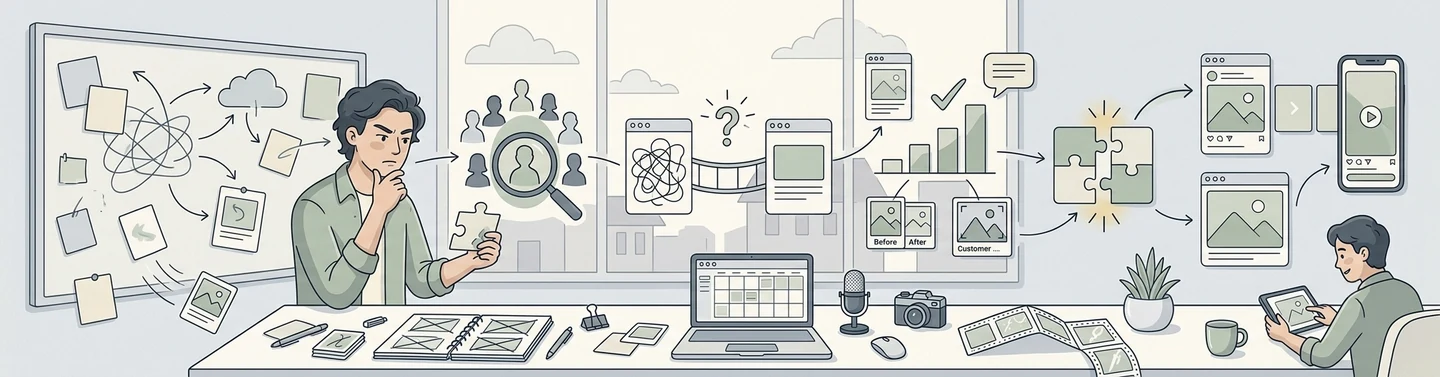
You do not need a list of 500 phrases to copy. You need a repeatable way to find the tension already inside your own content. These six steps take about ten minutes and work for any format.
1.Name the exact audience
Weaker
Here is a useful marketing tip.
Stronger
For restaurant owners photographing food after sunset.
The second version gives exactly one group a reason to identify themselves, and everyone else permission to scroll.
2.Name the useful change
Ask what the person will be able to do afterwards that they cannot do now:
- What will they understand?
- What mistake will they avoid?
- What decision becomes easier?
- What question finally gets answered?
Weaker
Let us talk about content planning.
Stronger
How to turn one promotion into a week of posts that do not repeat each other.
3.Find the tension
Tension is the gap between two things. Almost every strong hook contains one:
- Expectation and reality
- Problem and solution
- Before and after
- Common belief and better explanation
- Current situation and desired outcome
Weaker
Five caption tips
Stronger
Five caption changes for posts that get views but no enquiries
4.Add credibility
Credibility can come from a visible demonstration, a real example, a defined test, firsthand experience, customer evidence, a specific number, or simply a limited and believable claim.
Weaker
This trick will change everything.
Stronger
We changed only the first slide and compared the results.
5.Cut the introduction
Delete these before publishing. Every one of them delays the reason to stay:
- Hey everyone / Welcome back
- Today I want to talk about
- You may be wondering
- We are excited to announce
- In today’s fast-paced world
- Keep watching to find out
Then start at the interesting part. It is almost always already in your draft, about three sentences down.
6.Match the hook to the payoff
Before publishing, finish this sentence honestly:
Written
After seeing this hook, the audience reasonably expects the content to deliver ______.
Then check that it does. A hook about a pricing mistake has to explain a pricing mistake. It cannot open onto a company introduction followed by a sales pitch. This one check catches most accidental clickbait, because almost nobody sets out to write it deliberately.
Hooks by format
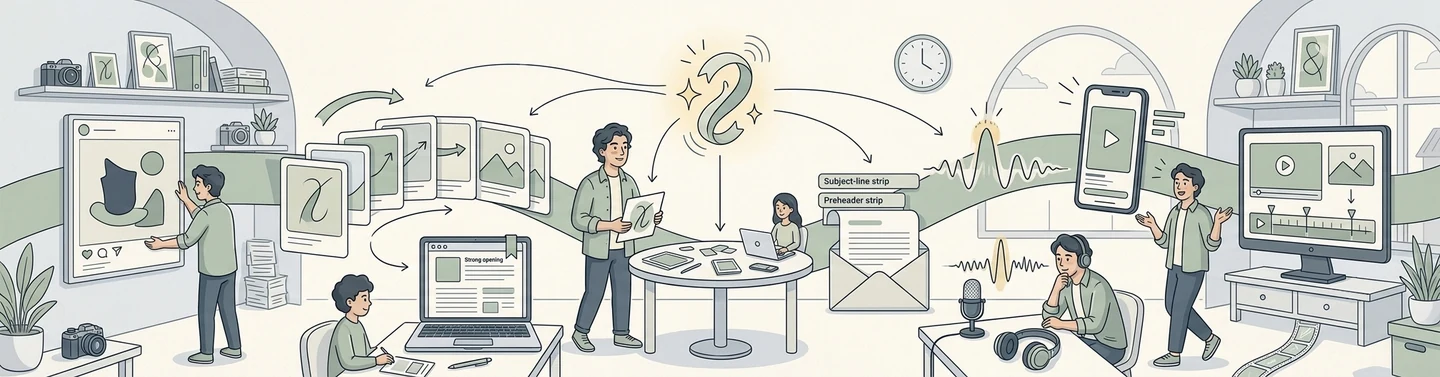
Static image posts
The image and the headline have to work as one unit. A photo of a new product captioned “New product” contains no tension at all.
Weaker
New product
Stronger
We finally made the travel size customers kept asking for
The image should show the thing that makes the announcement worth reading: in this case, the size difference.
Carousels
Slide one earns the swipe. Slide two proves the swipe was worth it. Most carousels fail on slide two.
Written
Slide one: your content pillars may be causing repetitive posts.
Written
Slide two: these three pillars are the same idea with different labels.
The common mistake is a strong first slide followed by three slides of introduction. If slide two is a restatement, the carousel has already lost.
Captions and LinkedIn posts
The first line has to make sense on its own, before the “see more” cut.
Weaker
We have been reflecting on something important lately.
Stronger
Our most polished post last month produced the fewest qualified enquiries.
Articles and blog posts
The title should promise the answer the searcher wanted, and the introduction should confirm within a few lines that the article delivers it. Do not spend five paragraphs establishing that social media is competitive. The reader already demonstrated intent by searching.
In email the hook is split across three elements, and the common error is making all three say the same thing.
Written
Subject: your August content plan is ready
Written
Preheader: three posts still need approval
Written
First line: the campaign stays on schedule once the final product images are confirmed.
Each element adds new information. Together they tell a complete story before the reader has opened anything.
Podcasts
A podcast hook can be a short clip from the most revealing moment, a question the episode answers, a surprising line from the guest, or a brief story that leads into the topic.
What it should not be is several minutes of housekeeping. Sponsor reads and admin can wait until after new listeners have a reason to stay.
Short-form video
Combine a first frame that already contains information, a concise spoken line, readable on-screen text and captions for sound-off viewing. A structure that works:
- State the problem or the result
- Show why the answer is not obvious
- Say what the viewer will be able to do
- Start the actual content
Do not repeat the title word for word, play a logo animation and then introduce the topic a second time. That is three openings before anything happens.
Longer video
Long-form has a second hook most people forget: the moment just after the introduction, where viewers decide whether to commit to another eight minutes. Preview the most interesting thing that happens later, then get to it. A promise made at second five and kept at minute nine is what earns the rest of the watch time.
Common hook mistakes
Six of these seven come up constantly in real content reviews. The last one is the most expensive.
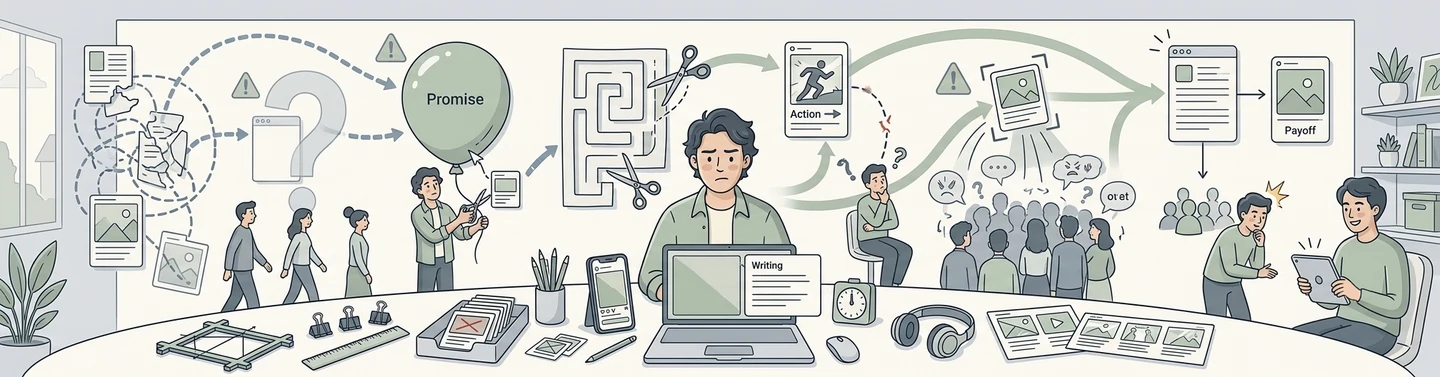
Mystery with no context
Nobody is talking about this.
Specific enough to matter
Most content calendars track publish dates but ignore approval delays.
The audience cannot tell whether an unnamed “this” is relevant to them, so they assume it is not.
Claim bigger than the content
This one tip will make your business unstoppable.
Claim the content can carry
This approval step prevents most last-minute caption changes.
Gives away the whole lesson
Put the product beside a window at 45 degrees and use white card opposite to fill the shadow.
Leaves a reason to continue
This piece of white card fixed the harsh shadow in our product photos.
A hook should make the value clear without making the content redundant.
Written for everyone
Everyone needs to hear this.
Written for someone
Freelancers sending creative work for client approval need to hear this.
Aggression standing in for confidence
Stop doing this immediately.
Precision
This works well for large teams but adds steps for solo owners.
Precision earns more trust than intensity, and it ages better.
Copying a viral hook word for word
A formula can be adapted. A personality cannot be borrowed. Phrases like “POV”, “nobody talks about this” and “I was today years old” can work when they genuinely fit the subject, but repeating them mechanically makes a brand sound interchangeable with thousands of other accounts.
Using a hook unrelated to the payoff
A dramatic clip followed by an unrelated lesson will stop the scroll, and it will also teach the platform to show your next post to people who do not want it. The first frame should belong to the content. This is the mistake that quietly damages an account over months rather than in one post.
Testing whether a hook worked
The usual mistake is changing the entire post and then crediting the hook for the result. For a test that actually tells you something:
- Keep the topic and the payoff identical
- Write two or three genuinely different openings
- Publish in comparable conditions where you can
- Compare the metrics closest to the hook, not the vanity ones
- Record which kind of audience each version attracted
For written and static content, look at
- Carousel continuation from slide one to slide two
- Saves and shares
- Profile visits and link clicks
- Whether the comments are about the actual topic
For video, look at
- Early drop-off in the first few seconds
- Average watch time and completion rate
- Rewatches, which often indicate a hook that was slightly too fast
- Comments that show the message was understood, not just noticed
A high view count with poor retention and unrelated comments is not a success with a measurement problem. It is a hook that attracted the wrong audience, and it is worth treating as a failed test rather than a good day.
Test different types, not different adjectives
Changing “three content mistakes” to “the three biggest content mistakes” teaches you nothing. Test approaches that differ structurally:
- Problem: why clients keep requesting last-minute changes
- Contrarian: more detailed briefs do not always reduce revisions
- Experiment: we gave the same brief to three designers
- Outcome: a simpler way to collect approval on client content
The winner tells you something durable about what your audience values, which is worth far more than knowing they prefer one adjective.
A five-question checklist before you publish
- Is the topic clear? Can someone tell what this is about immediately?
- Is the audience recognisable? Will the right person know it applies to them?
- Is there a reason to continue? Does the opening create a real question or expected payoff?
- Is the claim believable? Can the content support what the hook promises?
- Does the next part deliver quickly? Or does it restart with an introduction?
A hook that passes all five does not need exaggerated language to work.
Planning hook variations with a team or a client
The strongest hook usually appears during editing, not during the first brainstorm. That only happens if the plan has somewhere to put alternatives.
When you plan content, keep separate fields for:
- Core topic and intended audience
- Two or three hook options rather than one
- Opening visual, spoken opening and text overlay
- The proof that supports the claim
- Call to action, status and approval feedback
For anything important, write at least three hook options before design or filming starts. It stops the whole piece being built around whichever idea someone typed into the calendar first.
A shared planning and approval view also helps copywriters, designers, video editors and clients confirm that the first frame, the caption and the creative all promise the same thing, which is exactly the mismatch that produces accidental clickbait. If you already plan in a spreadsheet, Calipzo turns that Google Sheet into a review calendar a client can open with one link, approve or comment on, with the sheet staying the source of truth. Our guide to content planning in Google Sheets covers the column structure that makes hook variations easy to track.
Questions people ask about hooks
What is a social media hook?
A social media hook is the opening part of a post or video that gives someone a reason to stop and continue. Depending on the format it can be the first sentence of a caption, a headline on a static image, the first slide of a carousel, an email subject line, or the first frame, spoken line, on-screen text or sound in a video.
How long should a social media hook be?
As short as it can be while still communicating one clear idea. Most written hooks fit in a single sentence. In short video the hook starts in the first frame and the first spoken line, though the full setup often runs a few seconds longer before the main content begins.
How do you hook viewers in the first three seconds?
Open with information rather than introduction. Show the result, the problem, the comparison or the central question immediately, and make the spoken line, the on-screen text and the visual all point at the same idea. TikTok advises advertisers to introduce the content proposition in the first three seconds and to prioritise the hook within the first six.
What is a visual hook?
A visual hook is the image, action, object, expression or transformation that communicates something before the viewer processes any words. Common examples are a finished result shown before the method, a visible problem, a side-by-side comparison, or an experiment already in progress.
What are good hooks for Instagram Reels?
Reels respond well to a clearly stated problem, a concrete outcome, a before and after comparison, a visible demonstration, or a situation the intended audience recognises immediately. The right choice depends on the subject and who you are trying to reach, not on a fixed list of phrases.
Can the same hook be used on TikTok, Instagram Reels and YouTube Shorts?
The underlying idea usually transfers, but the execution often needs adjusting. Pacing, text placement, caption length, on-screen text density and cultural references differ between platforms and between audiences, so the same core hook may need a different opening frame or a different first line on each.
How do you write a hook without using clickbait?
Promise only what the content actually delivers, then deliver it quickly. Curiosity is not dishonest when the withheld answer genuinely arrives. A hook becomes clickbait when the payoff is smaller than the promise, when the opening describes something the content never covers, or when the interesting moment is unrelated to the subject.
Should every video have text on screen?
Not every video needs a large headline, but readable on-screen text helps people who watch without sound and makes the topic clear before the audio has explained it. TikTok suggests using captions or text overlays for context and displaying roughly five to ten words per second. Text should add information rather than reproduce the whole spoken script.
Should you write the hook before or after making the content?
Write a provisional hook first so the content has direction, then rewrite it once the content exists. The finished piece often contains a stronger result, example or moment than the one you planned around, and that moment usually makes the better opening.
What is the best hook formula?
No single formula works for every topic, which is why copying a viral phrase rarely transfers. A reliable starting structure is a specific audience, a recognisable tension and a credible payoff. For example: for small businesses posting consistently but getting few enquiries, here are three ways to make the offer clearer.
A good hook does not have to sound viral
It has to make the value of the content visible early, to the right person. That is a smaller and much more achievable target than going viral, and it is the one that compounds.
Start with the audience. Find the problem, question, contrast or result. Choose the opening that communicates it most directly, whether that is a sentence, a frame, a sound or a comparison. Then make sure the rest of the content keeps the promise.
Attention begins with the hook. Everything after it decides whether that attention was worth having.
About the examples in this guide
Every case study links to a video published on the account that made it, so you can check the mechanic for yourself rather than take a summary on trust. All of them were published between 2024 and 2026, because a guide about openings in current feeds should point at current work. Platform guidance is quoted from TikTok’s published creative best practices for advertisers and was checked against that page on 30 July 2026.
Campaign specifics and platform recommendations change. The written and video examples throughout are original illustrations of each pattern, not claims about results any particular business achieved.