
Tech & language
40 New Tech Terms That Broke Out in 2026, and Which Ones Will Last
Forty tech terms breaking into common use in 2026, from harness engineering and prompt debt to agent washing and Google Zero: what each means and whether it will last.
Published 34 min read
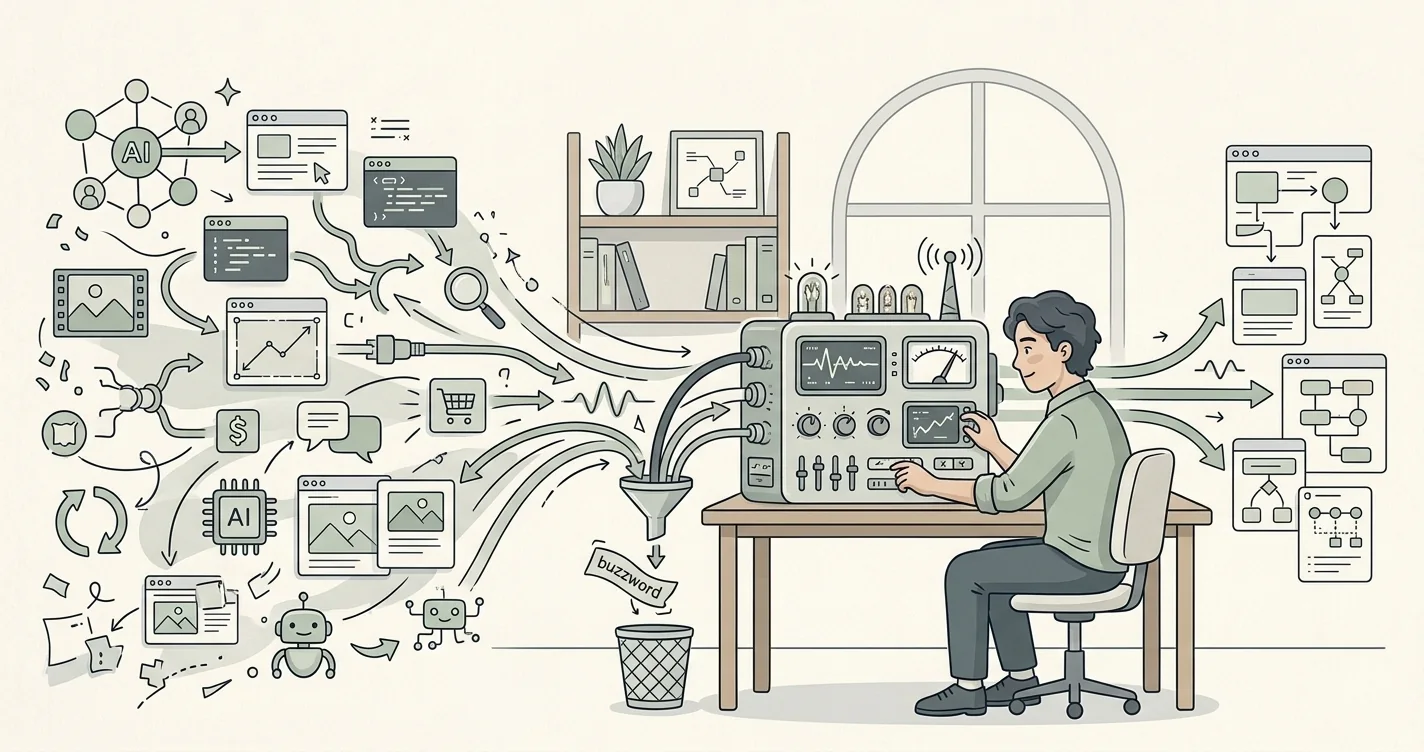
The vocabulary that is hard to follow in 2026 is not the vocabulary of AI itself. Model, prompt, agent and hallucination are widely understood by now. The words that stop people are the newer ones, invented or repurposed to describe what happens after those things arrive inside a company.
Harness engineering. Prompt debt. Agent washing. Workslop. Slopsquatting. Google Zero. None of them existed as common vocabulary two years ago. All of them now turn up in release notes, board decks, job descriptions and security reviews, usually with no explanation attached.
This guide covers 40 of them. Each entry says what the term means, where it came from and who is pushing it, whether the idea underneath is genuinely new or an old idea wearing a new name, and whether the word is likely to survive. Each one also carries a short example of how the term is actually used, because a definition rarely tells you how a word behaves in a sentence.
A term earned a place by being encounterable and under-explained. It had to be something you could plausibly meet in the next year or so without going looking for it, and something the existing explanations handle badly. That rule keeps out the very obscure, and it also keeps out the very obvious.
So several familiar words are deliberately missing. Vibe coding, prompt engineering, RAG, hallucination, MCP, AI slop and machine learning are all in wide use and already well covered, and they appear here only where a newer term is defined against them. Generative UI, AI coworker and agentic coding were considered and left out for a different reason: they are descriptions rather than terminology, and none of them tells you anything the plainer phrase would not.
How to read this list
Calling a term “new” hides four quite different situations, and separating them explains most of the confusion around technology vocabulary. Every entry below states which one it is.
- Newly coined. The phrase itself was invented recently, usually by one identifiable person or company. Prompt debt, context rot and the lethal trifecta are examples.
- Vendor-coined. A company named it and has a commercial interest in it spreading. Agent boss, service-as-software, vibe design and vibe directing all began this way.
- Revived. An older word doing new work. Shadow AI is shadow IT rewritten, and clanker is decades-old science fiction slang pointed at a delivery robot.
- Breakout. The term existed inside a small community and reached general use in this cycle. Neocloud, non-human identity and eval-driven development travelled that way.
The second question is whether a word will still be current in a few years, which is a separate judgement from whether the thing it describes is real. Each entry carries one of four verdicts, and the summary table uses the same four.
- Likely to last. Names something structural, has a stable definition, and no obvious competitor for the same meaning.
- Idea lasts, name may not. The phenomenon is real and permanent, but the label is contested or competing with a rival.
- Too early to call. Months old, tied to a product launch or a proposal that has not yet shipped broadly.
- Watch for hype. Used more loosely or more confidently than the evidence supports, usually by people selling something.
All 40 terms at a glance
Every term links to its full entry. On a narrow screen the table scrolls sideways.
| No. | Term | What it means | Staying power |
|---|---|---|---|
| 1 | Vibe engineering | Experienced engineers using AI agents with tests, review and planning intact | Idea lasts, name may not |
| 2 | Agentic engineering | Professional engineering built around directing and verifying coding agents | Likely to last |
| 3 | Harness engineering | Engineering the environment around a model: tools, tests, permissions, feedback | Likely to last |
| 4 | Spec-driven development | Writing a structured specification first and having agents build against it | Likely to last |
| 5 | Ralph Wiggum Loop | Running an agent in a loop on one goal until a check finally passes | Idea lasts, name may not |
| 6 | Continuous AI | Agents running automatically in a repository the way CI jobs already do | Too early to call |
| 7 | Context engineering | Designing everything a model sees at inference, not just the prompt | Likely to last |
| 8 | Context rot | Accuracy degrading as the input context grows longer | Likely to last |
| 9 | Prompt debt | Maintenance cost from behaviour patched into prompts instead of code | Likely to last |
| 10 | Eval-driven development | Treating a suite of evaluations as the spec and the release gate | Idea lasts, name may not |
| 11 | Agent Skills | A folder that teaches an agent one job, loaded only when it is needed | Likely to last |
| 12 | WebMCP | A proposed browser standard letting a site offer its actions to AI agents | Too early to call |
| 13 | Agentic web | A web built to be operated by software agents as well as read by people | Idea lasts, name may not |
| 14 | Agentic commerce | Buying where an agent does the research, the comparison or the transaction | Likely to last |
| 15 | Agentic search | Search run as a loop of query, inspect, reformulate and verify | Likely to last |
| 16 | Query fan-out | One question quietly becoming many searches across subtopics and sources | Likely to last |
| 17 | Share of Model | How often a brand appears in AI answers across a chosen set of prompts | Watch for hype |
| 18 | llms.txt | A proposed plain-text file telling AI systems what a site contains | Watch for hype |
| 19 | Google Zero | The scenario where Google sends publishers little or no referral traffic | Idea lasts, name may not |
| 20 | Lethal trifecta | The three agent capabilities that combine into a data-leak risk | Likely to last |
| 21 | Slopsquatting | Registering a package name an AI model invented, then waiting | Likely to last |
| 22 | Shadow AI | Employees using AI tools the organisation never approved | Likely to last |
| 23 | Agent sprawl | Agents accumulating faster than anyone can own, connect or retire them | Likely to last |
| 24 | Non-human identity | The credentials and permissions belonging to machines rather than people | Likely to last |
| 25 | Agent washing | Marketing ordinary automation or a chatbot as an autonomous agent | Likely to last |
| 26 | Agent boss | An employee whose job now includes assigning work to agents and checking it | Idea lasts, name may not |
| 27 | Workslop | AI output that looks finished and pushes the real thinking onto the reader | Likely to last |
| 28 | Cognitive debt | The long-run cost of outsourcing thinking you would otherwise have done | Idea lasts, name may not |
| 29 | Job hugging | Staying in a job out of caution rather than satisfaction | Idea lasts, name may not |
| 30 | Service-as-software | Selling the finished outcome instead of the tool someone uses to get there | Likely to last |
| 31 | One-person unicorn | A billion-dollar company run by one founder and a stack of agents | Watch for hype |
| 32 | Outcome-based pricing | Charging per result delivered rather than per seat or per month | Likely to last |
| 33 | Neocloud | A cloud provider that rents almost nothing except accelerated compute | Likely to last |
| 34 | Circular financing | A supplier funding the customer that spends the money back on the supplier | Likely to last |
| 35 | Sovereign AI | A country keeping the compute, data and models behind public functions in reach | Likely to last |
| 36 | Vibe design | Describing an intent or a feeling and having AI produce the interface | Too early to call |
| 37 | Vibe directing | Directing AI-generated video in conversation instead of assembling it | Too early to call |
| 38 | Synthetic users | Model-generated stand-ins for customers in research and testing | Watch for hype |
| 39 | Content Credentials | Tamper-evident data attached to a file recording how it was made | Likely to last |
| 40 | Clanker | An insult for robots and AI, used as a joke and increasingly in earnest | Idea lasts, name may not |
Building software with agents
More new vocabulary has come out of software engineering than anywhere else, because that is where agents arrived first and where the failure modes showed up fastest.
1.Vibe engineering
Simon Willison proposed vibe engineering in October 2025 to split a phrase that had been doing two jobs at once. Vibe coding, as Andrej Karpathy originally meant it, is building software without really reading the code. Willison’s objection was that the same phrase had been stretched to cover serious teams shipping production systems with agents, which is a different and harder activity with very different success rates. Simon Willison
Vibe engineering keeps the parts vibe coding deliberately drops: automated tests, planning, documentation, code review, and enough research skill to know when the agent is confidently wrong. The agent is treated as fast and fallible rather than as an oracle.
- Where it came from
- Newly coined. Simon Willison, October 2025.
- Staying power
- Idea lasts, name may not. Agentic engineering is competing for the same meaning.
In a sentence
It is not vibe coding if you read every diff and the suite has to go green first. That is vibe engineering.
2.Agentic engineering
Agentic engineering describes professional software engineering in which agents perform a large share of the implementation while engineers supply architecture, constraints, review and verification. Karpathy popularised the phrase in February 2026, and set it against his own earlier term at Sequoia’s AI Ascent that April: vibe coding, he said, “is about raising the floor for everyone in terms of what they can do in software”, while agentic engineering “is about preserving the quality bar of professional software”. Karpathy
It has been adopted faster than vibe engineering, mostly by companies with something to sell into it. The two terms mean roughly the same thing, which is worth knowing before you assume a job description using one of them is describing something the other is not.
- Where it came from
- Newly coined. Popularised by Andrej Karpathy, February 2026.
- Staying power
- Likely to last. Broadest institutional adoption of the competing names.
In a sentence
We hire for agentic engineering now, so the interview is about how you constrain and check an agent, not whether you can write a binary search on a whiteboard.
3.Harness engineering
The model is one component. The harness is everything around it: the tools it can call, the tests it can run, the permissions it holds, the logs it can read, the environment it executes in, and the feedback that tells it whether the last attempt worked.
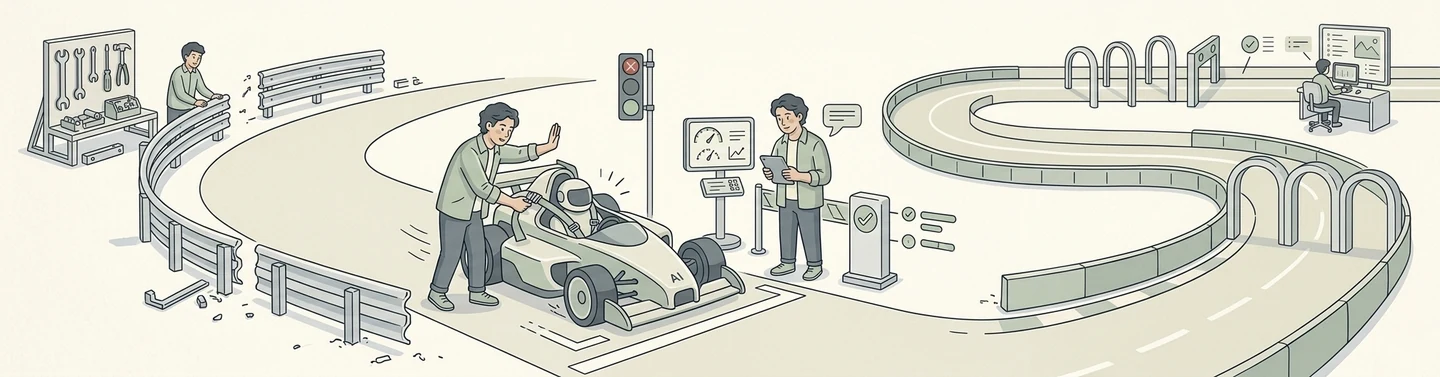
OpenAI named the discipline in February 2026, describing roughly five months from August 2025 in which a small team shipped production software where Codex agents wrote every line, adding up to around a million lines of code across application logic, tests, CI configuration, documentation and observability tooling. OpenAI
The transferable claim is not the line count. It is that when producing code becomes cheap, the constraint moves to the environment the code is produced in. Anything an agent cannot reach in context effectively does not exist, so knowledge living in chat threads and people’s heads has to move into the repository. Custom lint rules start carrying remediation instructions in their error messages, because the error message is now an input to another agent rather than a note to a human.
- Where it came from
- Vendor-coined. Named by OpenAI, February 2026.
- Staying power
- Likely to last. Names a real engineering problem better models do not solve.
In a sentence
The model was fine. Our harness was the problem: the agent could not run the integration tests, so it kept guessing.
4.Spec-driven development
Spec-driven development, usually shortened to SDD, puts a reviewed specification in front of the agent instead of a prompt. Requirements, expected behaviour, design and a task breakdown are written and agreed first, and the implementation is generated against that document.
Amazon made the workflow the centre of Kiro, announced in July 2025 and generally available from March 2026. Kiro GitHub’s spec-kit pushes a similar shape. The argument behind all of them is economic rather than aesthetic: as implementation gets cheaper, precisely specifying what should be built becomes the scarce and valuable input.
- Where it came from
- Vendor-coined. Central to Amazon’s Kiro from July 2025, now used more broadly.
- Staying power
- Likely to last. Describes a real response to unconstrained agent output.
In a sentence
Do not open the agent yet. Write the spec, get it reviewed, and let it build against that.
5.Ralph Wiggum Loop
Named after the Simpsons character, deliberately. Geoffrey Huntley described the technique in May 2025: run an agent against a fixed goal in a loop, give it a fresh context on each pass, and keep going until a stated completion condition holds. Geoffrey Huntley
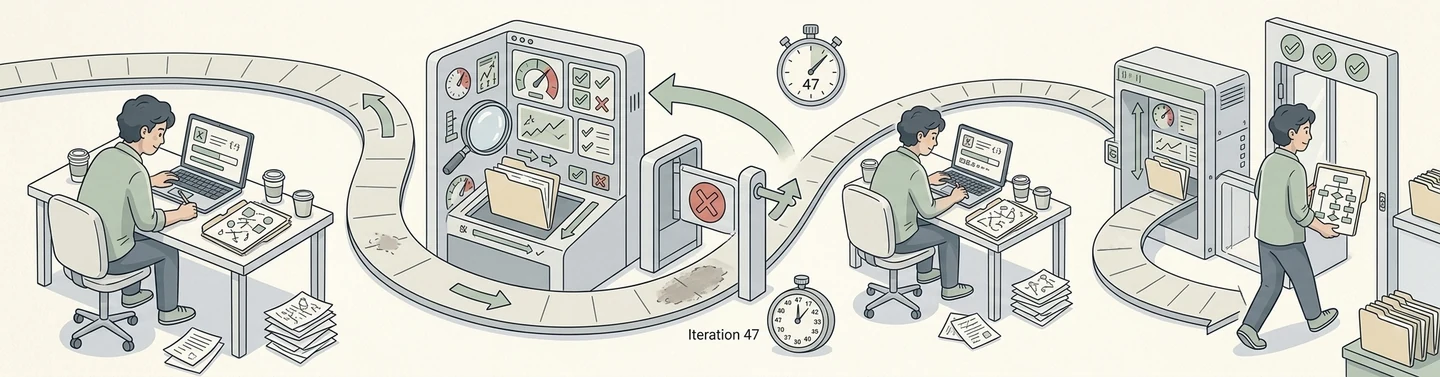
In its original form it is close to a shell while loop. That is the joke, and it is also the point. The technique works not because it is clever but because it pairs persistence with a verifiable stop condition, and because a fresh context each iteration avoids the slow degradation of one very long session. The name may stay a niche in-joke. The pattern is now built into mainstream agent tooling.
- Where it came from
- Newly coined. Geoffrey Huntley, May 2025.
- Staying power
- Idea lasts, name may not. The pattern is spreading faster than the joke.
In a sentence
I ralphed it overnight against the failing test and it was green by the morning.
6.Continuous AI
An echo of continuous integration, and coined by GitHub Next in June 2025 as an umbrella for automated AI that supports software collaboration. GitHub Next CI runs deterministic rules on every push. Continuous AI runs judgement tasks on the same triggers: triaging an issue, summarising a long discussion, flagging an undocumented behaviour change, drafting release notes.
GitHub moved its Agentic Workflows into technical preview under this framing in February 2026. The open questions are cost and noise. Deterministic rules are cheap enough to run on every commit; reasoning is not, and a repository that comments on itself constantly becomes something people stop reading.
- Where it came from
- Vendor-coined. GitHub Next, June 2025.
- Staying power
- Too early to call. The category is clear, the economics are not.
In a sentence
We have continuous AI on the changelog now, so every merged pull request gets a plain-English summary without anyone asking.
7.Context engineering
Prompt engineering asks what instruction to write. Context engineering asks a larger question: what should be in the model’s window at the moment it makes a decision? That includes system instructions, tool definitions, retrieved documents, earlier turns, application state and any notes the agent has written to itself.
Anthropic set out the practice in September 2025, describing it as curating and maintaining the best set of tokens during inference, including information that lands there from outside the prompt entirely. The techniques it recommends are unglamorous and concrete: compaction, structured note-taking, and splitting work across sub-agents so no single context has to hold everything. Anthropic
- Where it came from
- Breakout. Practitioner shorthand formalised by Anthropic, September 2025.
- Staying power
- Likely to last. Already foundational to how long-running agents are built.
In a sentence
Stop rewriting the prompt. This is a context engineering problem, because the agent never sees the schema.
8.Context rot
More context is not automatically better context. Context rot is the measurable decline in model accuracy as the input grows longer, and it starts well before the advertised limit.
Chroma named it in a July 2025 technical report that tested 18 frontier models and found every one degraded as input length increased, unevenly and unpredictably rather than gracefully. Chroma The finding reframes a marketing number: a very large context window is a capacity, not a promise of accuracy at that length.
The practical consequence inverts the usual instinct. The problem is no longer giving a model enough information. It is deciding what to leave out.
- Where it came from
- Newly coined. Chroma technical report, July 2025.
- Staying power
- Likely to last. Names a reproducible, measured effect.
In a sentence
Six hours into that session the answers went vague. Classic context rot, so we compacted and started again.
9.Prompt debt
Technical debt applied to instructions. A prompt starts as one clear paragraph. An edge case appears, so somebody adds a sentence. Then an exception. Then a warning in capitals. Then a rule that quietly contradicts an earlier rule nobody remembers writing, and behaviour now depends on a fragile block of prose no one is willing to touch.
Drew Breunig popularised the term in June 2026, and O’Reilly republished the piece the following month. His argument is sharper than the analogy: “natural language was never meant to be a specification language for engineering, and treating it as one quietly caps what you can build.” He describes the debt arriving in stages, from slower iteration, to a prompt no one on the team can safely edit, to lock-in, because a prompt hand-tuned around one model’s quirks cannot easily be moved to another. Drew Breunig
- Where it came from
- Newly coined. Drew Breunig, June 2026.
- Staying power
- Likely to last. The problem exists whether or not this phrase survives.
In a sentence
That prompt is nine hundred words of accumulated prompt debt, and half of it is working around a bug we fixed properly in March.
10.Eval-driven development
A unit test asserts a deterministic result. An eval scores a probabilistic one against a graded dataset, and runs whenever a prompt, model, tool or retrieval step changes. Eval-driven development treats that suite as both the specification and the release gate.
The practice hardened for an unglamorous reason: providers ship new model versions underneath a working application, and a change that fixes one case can silently break ten others that nobody is watching. There is no single coiner. The part that has genuinely entered common speech is “evals” as a plain noun, along with the job title evals engineer, which barely existed in 2023.
- Where it came from
- Breakout. Practitioner term, spread through 2025 and 2026.
- Staying power
- Idea lasts, name may not. The practice is settled, the label still varies.
In a sentence
The new model scored better on the public benchmark and worse on our evals, so we did not ship it.
11.Agent Skills
A skill is a folder: a SKILL.md file of instructions, plus any scripts, templates or reference files the job needs. The agent reads only the short description most of the time, and loads the full contents when a task actually calls for it, which is why skills scale where one enormous system prompt does not.
Anthropic launched them in October 2025 and released the format as an open standard that December, and other vendors’ agents now read the same files. Anthropic That cross-vendor adoption is why this is worth learning as vocabulary rather than as one company’s feature name.
- Where it came from
- Vendor-coined. Anthropic, October 2025, opened as a standard in December 2025.
- Staying power
- Likely to last. Solves a real packaging problem and is no longer single-vendor.
In a sentence
Do not paste the brand guidelines into the chat again. Put them in a skill and every agent picks them up.
The web agents are rebuilding
The web assumes a person is reading it. A growing share of the traffic is not a person, and the standards work responding to that has produced its own vocabulary.
12.WebMCP
Today a browser agent works a website the way a person does: read the page, infer what a button probably means, click it, hope. WebMCP is a proposed standard that lets a site declare its own actions in machine-readable form, so the agent calls a defined tool instead of guessing from the layout.
Chrome confirmed at Google I/O in May 2026 that WebMCP moves from a flag-gated preview into a public origin trial in Chrome 149. Chrome for Developers
It is not a replacement for MCP, and the two are easy to confuse. MCP connects an AI application to external systems. WebMCP exposes one page’s own actions to an agent that is already in the browser. If it lands, it could affect web development roughly the way structured data affected search, except that the audience is something that wants to act rather than merely understand.
- Where it came from
- Newly coined. Web standards proposal, Chrome origin trial from May 2026.
- Staying power
- Too early to call. High potential, still an origin trial.
In a sentence
Once we ship WebMCP the assistant can actually book the appointment instead of guessing which button does it.
13.Agentic web
The umbrella over browser agents, WebMCP and machine-readable commerce: a web that assumes software may discover information, compare options, fill forms and complete transactions on someone’s behalf.
The design question it forces is narrow and answerable, which is the useful part. Is this page merely readable, or is the service behind it operable by something that is not a person? Treat the phrase itself with some caution, though. It is also convenient marketing for anyone selling agent infrastructure, and the standards that would make it real are still mostly proposals.
- Where it came from
- Breakout. Industry framing, used prominently by Google through 2026.
- Staying power
- Idea lasts, name may not. The shift is real, the label is doing sales work too.
In a sentence
If we are serious about the agentic web, our booking flow cannot depend on a dialog that only opens on hover.
14.Agentic commerce
Shopping in which an AI agent participates directly in discovery, comparison or the purchase itself. Two protocol families are competing to define it: the Agentic Commerce Protocol from OpenAI and Stripe, and Google’s Universal Commerce Protocol, co-developed with Shopify and a group of retailers and payment companies and expanded through 2026. Google
The merchant consequence is more concrete than the phrase suggests. A product page written to persuade a person is not the same artefact as a feed of inventory, price, availability, shipping and return terms that an agent can read and act on. Returns policy stops being a page nobody visits and becomes a product attribute that decides whether you get selected.
- Where it came from
- Breakout. Category term, protocol work from 2025 into 2026.
- Staying power
- Likely to last. Backed by payment rails and live merchant integrations.
In a sentence
Agentic commerce means our returns window is now a field in a feed, not a paragraph in the footer.
How things get found now
Search is no longer one query returning ten links to a person. Five terms describe what replaced it, and they matter to anyone who publishes anything.
15.Agentic search
Traditional search is request and response. Agentic search is a loop: set a goal, search, inspect the results, reformulate, search again, gather evidence, verify, synthesise.
It is now measured rather than theorised. A 2026 study analysed 14.4 million real search requests across 3.97 million agent sessions logged between June and December 2025, and found that more than 90% of multi-turn sessions finish within ten steps, that 89% of the gaps between steps are under a minute, and that on average 54% of the terms in a newly issued query already appear in evidence the agent had retrieved earlier. arXiv
Machines are a distinct class of search user now, with measurably different behaviour from people.
- Where it came from
- Breakout. Research and industry term, hardened during 2025 and 2026.
- Staying power
- Likely to last. Now a named problem in information retrieval research.
In a sentence
Half our search traffic is agentic search now, which is why average session length collapsed.
16.Query fan-out
Google’s own term, and one of the most useful on this list for anyone publishing. Its Search Central documentation states that AI Overviews and AI Mode “may use a ‘query fan-out’ technique, issuing multiple related searches across subtopics and data sources, to develop a response”. Google Search Central
One broad question can therefore become a set of quieter searches about definitions, comparisons, prices, alternatives, risks and specific cases. What follows for content strategy is not a trick. A page is no longer competing only for the phrase somebody typed. It is competing to be useful evidence for branches of a question that were never typed at all, which rewards genuine coverage over exact-phrase repetition.
- Where it came from
- Vendor-coined. Google, March 2025, in its AI Mode announcement.
- Staying power
- Likely to last. Describes an actual retrieval mechanism, documented by Google.
In a sentence
Nobody searched that phrase. Query fan-out did, and that is where the citation came from.
17.Share of Model
Share of Model is the AI-answer analogue of share of voice: how often a brand appears across a defined set of prompts, compared with its competitors. Marketing tools also sell it as AI visibility, citation share or presence rate.
The underlying question is legitimate, because people genuinely do ask assistants which product to buy. The measurement is where care is needed. Answers vary by model, by version, by phrasing, by region, by personalisation and by the day, and every vendor reporting a Share of Model number chooses its own prompt set. Treat the figure as a reading from one instrument rather than as a ranking, and be suspicious of any trend line that survived a change to the prompt set.
- Where it came from
- Breakout. Marketing metric with no standard methodology behind it.
- Staying power
- Watch for hype. Real question, soft measurement, vendor-defined inputs.
In a sentence
Share of Model is up, but they changed the prompt set last month, so I would not spend against it yet.
18.llms.txt
A proposed plain-text file at a site’s root, summarising what the site contains and linking its important pages so an AI system does not have to infer the structure from navigation. llmstxt.org
It is a useful case study in how quickly a proposal becomes a checklist item. Adoption grew through 2026, helped by publishing plugins that generate the file automatically. Google’s guidance points firmly the other way: “You don’t need to create new machine readable files, AI text files, or markup to appear in these features.” No major AI provider has committed to reading it. The file is cheap to publish and harmless, and that is a very different claim from the one usually made for it.
- Where it came from
- Newly coined. Proposed by Jeremy Howard, September 2024, widely discussed in 2026.
- Staying power
- Watch for hype. Low cost, contested value, no committed consumers.
In a sentence
We publish an llms.txt, but I would not tell a client it moves anything in Google.
19.Google Zero
Coined by Nilay Patel of The Verge around 2024 as a thought experiment for publishers: what does your business do if Google traffic goes to zero? Digiday
The absolute zero is rhetorical. The direction is not. Through 2025 and 2026 publishers reported steep declines in search referrals, and some began planning around an operating model that does not assume them, which is a much bigger change than a traffic dip. Google’s position is that AI features create new ways for people to discover sites and that it wants a healthy web ecosystem. Both things can be true, and the disagreement is really about who absorbs the transition.
- Where it came from
- Revived. Coined by Nilay Patel of The Verge, around 2024, newly urgent in 2026.
- Staying power
- Idea lasts, name may not. The scenario is real, the word is a rhetorical shorthand.
In a sentence
We are planning for Google Zero, which mostly means the newsletter has stopped being a side project.
Security and governance
Agents introduced failure modes that existing security language did not cover, and the words filling that gap are among the most useful on this list.
20.Lethal trifecta
Simon Willison named it in June 2025: access to private data, exposure to untrusted content, and the ability to communicate externally. Simon Willison
Any two of the three are usually manageable. All three at once means text an attacker controls can instruct an agent that can read your data and send it somewhere. The term is valuable because it converts a vague anxiety about prompt injection into something you can check against an actual deployment in about a minute, which is why it spread through security teams rather than through marketing.
- Where it came from
- Newly coined. Simon Willison, June 2025.
- Staying power
- Likely to last. Already a standard checklist in agent security reviews.
In a sentence
It reads customer email, it has database access and it can post to Slack. That is the lethal trifecta, and it ships tomorrow.
21.Slopsquatting
Typosquatting relies on a human typing a package name slightly wrong. Slopsquatting relies on a model inventing one. Language models routinely suggest plausible package names that do not exist; an attacker registers the invented name and waits for a developer to copy the suggestion, or for an agent to install it without anyone watching.
The scale is what makes it practical rather than theoretical. A study presented at USENIX Security 2025 generated 576,000 code samples across two languages and found average package hallucination rates of at least 5.2% for commercial models and 21.7% for open-source ones, turning up more than 205,000 distinct invented package names. Names that recur across repeated runs are the ones worth camping on, and plenty of them do. USENIX Security 2025
- Where it came from
- Newly coined. Credited to Seth Larson and popularised by Andrew Nesbitt, 2025.
- Staying power
- Likely to last. Names a measured, reproducible attack surface.
In a sentence
It suggested a package that does not exist, which is exactly the gap slopsquatting lives in.
22.Shadow AI
Shadow IT described technology employees used without approval. Shadow AI is the same idea pointed at AI tools, models and agents.
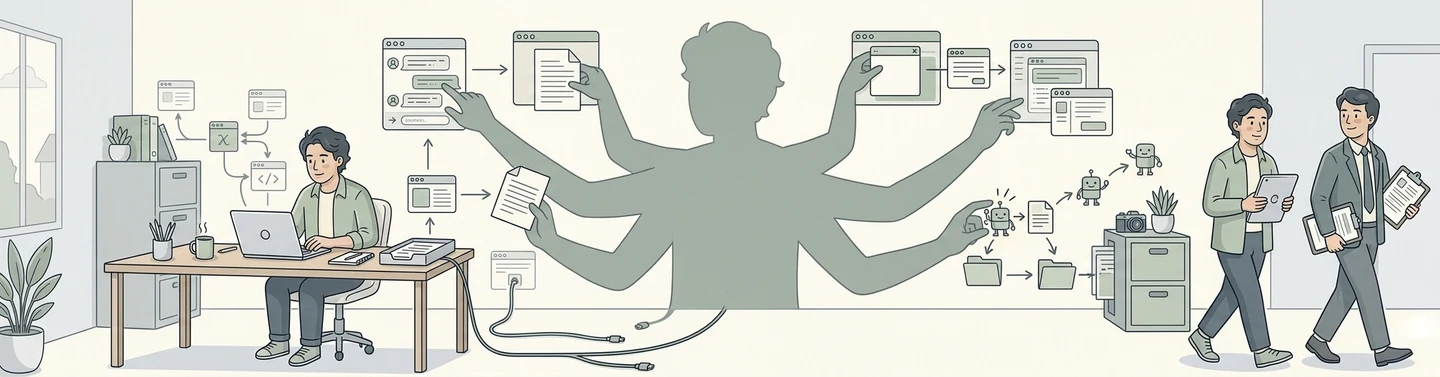
It is one of the older terms on this list, and it is here because the boundary is getting harder to see rather than easier. When shadow AI meant an employee pasting a contract into a consumer chatbot, it was identifiable. Now assistants live in the browser, the code editor, the note-taking app and the meeting recorder, often enabled by default in a suite the company already bought, and “unapproved” stops being a clean category. IBM
Worth distinguishing from agent sprawl, which is the next entry. Shadow AI is an authorisation problem. Sprawl happens among systems that were all approved.
- Where it came from
- Revived. Shadow IT adapted for AI, in wide use since 2023.
- Staying power
- Likely to last. The category is getting harder to police, not easier.
In a sentence
It is not shadow AI if IT approved the suite. The transcription feature came with it.
23.Agent sprawl
SaaS gave organisations app sprawl. Agents are giving them agent sprawl: a growing population of agents without consistent ownership, permissions, documentation or any process for retiring one.
IBM uses the term directly and separates it from shadow AI, noting that a large share of deployed agents operate in isolation rather than as part of a coordinated system, so the same integration gets built several times by different teams. IBM There is a neat trap inside it: restricting agents to control sprawl pushes people toward unapproved tools, which is the worse of the two problems.
- Where it came from
- Breakout. Enterprise term, in general use through 2026.
- Staying power
- Likely to last. Names a predictable organisational failure.
In a sentence
Nobody could say who owned the invoice agent or what it had access to. That is agent sprawl.
24.Non-human identity
Service accounts, API keys, CI pipelines, bots and now agents all authenticate and act without a person driving each step. Non-human identity, usually abbreviated NHI, is the collective name for them and for the governance problem they create.
Enterprise surveys have put machine identities well ahead of human ones in number for several years, and agents accelerate the gap because a single agent may hold several credentials across several systems. The practical gap is procedural rather than technical: joiner, mover and leaver processes were designed for employees, and nothing revokes an agent’s access when the project that created it ends.
- Where it came from
- Breakout. Security industry term, sharpened by agents in 2025 and 2026.
- Staying power
- Likely to last. Now a named budget line in enterprise security.
In a sentence
Every agent we deploy is another non-human identity, and right now none of them has an owner or an expiry date.
Work and the shape of the company
These are the terms most likely to reach people who never read an engineering blog, because they describe meetings, budgets and job descriptions rather than systems.
25.Agent washing
Rebranding ordinary automation, a chatbot or a fixed workflow as an autonomous agent. The word does the same rhetorical job as greenwashing and cloud washing before it: it questions whether the advertised category matches the capability.
Gartner, which coined the term, estimated in June 2025 that only around 130 of the thousands of vendors claiming to sell agentic AI were building anything that met the definition, and predicted that more than 40% of agentic AI projects would be cancelled by the end of 2027. Gartner
The buyer’s test is the genuinely useful part. Can it revise its own plan when the first attempt fails, or does it only ever run a fixed sequence with a language model on the front?
- Where it came from
- Vendor-coined. Gartner, widely quoted from June 2025.
- Staying power
- Likely to last. Useful anti-hype vocabulary with a testable definition.
In a sentence
Ask it to handle a case the flowchart does not cover. That is how you catch agent washing.
26.Agent boss
Microsoft introduced agent boss in its April 2025 Work Trend Index, alongside Frontier Firm, its term for an organisation rebuilt around teams of humans and agents rather than one that simply bought AI tools. Microsoft
Nobody is going to put agent boss on a business card. The underlying change is more consequential than the job title: the skill being described is management. Break work into pieces, delegate them, judge what comes back, notice when it is subtly wrong, intervene early enough to matter. Until now that was only required of people who managed people.
- Where it came from
- Vendor-coined. Microsoft Work Trend Index, April 2025.
- Staying power
- Idea lasts, name may not. Awkward label, real and spreading workplace change.
In a sentence
Half the role is agent boss now. I spend more time reviewing output than producing any.
27.Workslop
Workslop is AI-generated work that looks finished and transfers the actual thinking to whoever receives it. Researchers at BetterUp Labs and Stanford’s Social Media Lab named it in Harvard Business Review in September 2025. HBR
The test is a transfer of effort rather than a judgement of quality. If the sender saved ten minutes and the recipient spends thirty working out what was actually meant, nothing was produced. Their survey found around two in five workers had received it within a month, at roughly two hours of rework each time.
The most interesting finding is social rather than economic. Receiving workslop changes what colleagues think of the sender, which is a cost that does not appear on any productivity dashboard.
- Where it came from
- Newly coined. BetterUp Labs and Stanford Social Media Lab, September 2025.
- Staying power
- Likely to last. Almost every AI-using workplace recognises the behaviour.
In a sentence
Forty slides and no argument in any of them. Pure workslop, and I had to rewrite it anyway.
28.Cognitive debt
From a June 2025 MIT Media Lab study in which 54 participants wrote essays either with a language model, with a search engine, or unaided, while their brain activity was recorded. The model-assisted group showed the weakest measured connectivity of the three and were noticeably worse at quoting work they had just produced under their own name. MIT Media Lab
Two things are true at once, and most coverage picked only one. The study is small, specific to one task, and was widely overstated to the point that its authors published a note asking people to stop. The term still earns a place, because it names a trade-off people recognise in themselves: effort deferred now, at some cost to the capability later.
- Where it came from
- Newly coined. MIT Media Lab study, June 2025.
- Staying power
- Idea lasts, name may not. Widely overstated relative to the evidence.
In a sentence
Letting it write every first draft is cognitive debt. I have stopped being able to start a page cold.
29.Job hugging
The counterpart to job hopping. Korn Ferry gave the behaviour its name in August 2025: employees holding on to their current jobs rather than moving, driven by a slower hiring market, a shrinking pay premium for switching, and uncertainty about which roles still exist in a few years. Korn Ferry
It matters because of how it reads on a dashboard. Low attrition normally signals a healthy organisation. Job hugging produces the same number from the opposite cause, which is a workforce staying put without being engaged, and managers who mistake one for the other tend to find out late.
- Where it came from
- Newly coined. Korn Ferry, August 2025.
- Staying power
- Idea lasts, name may not. Labour-market trend labels rarely outlive their conditions.
In a sentence
Attrition is at a five-year low, which sounds good until you notice it is job hugging.
30.Service-as-software
A deliberate inversion of software-as-a-service, argued by Foundation Capital from 2024 and spreading steadily since. SaaS sells access to a tool and the customer owns the outcome. Service-as-software sells the outcome itself. Foundation Capital
The interesting part is which budget it comes out of. A tool is compared with other tools; a delivered outcome is compared with a salary or an outsourcing contract, which is a far larger number. Salesforce’s “digital labour” framing and the various “AI employee” pitches are the same argument in different clothes.
The obligation is usually left out of the pitch. Selling an outcome means owning the failures, and most software contracts have never had to say what happens when the work is simply done wrong.
- Where it came from
- Vendor-coined. Foundation Capital, 2024, in broad use by 2026.
- Staying power
- Likely to last. Names a genuine change in what is being bought.
In a sentence
They are not selling us a tool, they are selling resolved tickets, so it comes out of the support budget.
Money, compute and scale
Terminology from infrastructure and finance that has crossed into general business conversation, mostly because the numbers involved became too large to stay in the trade press.
31.One-person unicorn
A company worth a billion dollars run by a single founder with agents doing the rest. It is a prediction rather than an observation, popularised after Sam Altman suggested a ten-person and then a one-person billion-dollar company were coming.
The more useful term sits underneath it. Agentic leverage is the investor-side phrase for output per person when agents do a large share of the work, and it has genuinely changed how some firms assess small teams. Solo founding has risen sharply. Whether any one-person company reaches a ten-figure valuation is unproven, and the phrase does a great deal of work for people selling tools to solo founders.
- Where it came from
- Breakout. Investor and startup-press term, heavily debated through 2026.
- Staying power
- Watch for hype. Predicted rather than observed, with obvious sellers behind it.
In a sentence
Nobody has built a one-person unicorn yet, but the agentic leverage argument is why they funded a team of three.
32.Outcome-based pricing
Charging for results rather than for seats or a monthly licence. Per-seat pricing assumes seats, and when an agent does the work of several people the vendor’s revenue falls as its product succeeds, which nobody can sustain for long.
Customer support moved first, pricing per resolved conversation. The awkward parts are definitional rather than technical: what counts as a resolution, who adjudicates a disputed one, and how a finance team budgets for a bill that moves with volume. Most companies have landed on hybrids, with a platform fee plus a variable component, which is less elegant and much easier to sign.
- Where it came from
- Breakout. Pricing term, mainstream in AI software from 2025.
- Staying power
- Likely to last. Forced by the economics, not by fashion.
In a sentence
We moved to outcome-based pricing in March and then spent six weeks arguing about what counts as resolved.
33.Neocloud
A cloud provider that rents almost nothing except accelerated compute. Where a hyperscaler sells hundreds of services, a neocloud sells GPUs, the fast interconnect between them, and storage quick enough to keep them fed, usually on multi-year reserved contracts.
CoreWeave, Lambda, Nebius and Crusoe are the names that come up. The term is worth knowing mainly because it has crossed out of infrastructure trade press into general business coverage, and because the hyperscalers are now customers of these companies as well as competitors to them.
- Where it came from
- Breakout. Infrastructure term, mainstream in business press from 2025.
- Staying power
- Likely to last. Names a distinct and now sizeable market category.
In a sentence
Training moved to a neocloud because the reserved capacity came in cheaper than anything the hyperscalers would quote.
34.Circular financing
Also written as circular deals or round-tripping. A chip maker invests in a model company that commits to buying its chips. A cloud provider takes equity in a customer that commits to its capacity. Money leaves and returns, and revenue gets recognised at each stop.
Vendor financing is old and not automatically improper. The concern raised through 2026, including by the Bank for International Settlements in its annual report, is that recycled capital can look like new demand, which makes growth appear more broadly based than it is. It is now a standard question in earnings calls rather than a niche accounting objection.
- Where it came from
- Revived. Financial-press term applied to AI capital flows from 2025.
- Staying power
- Likely to last. Now a routine question about AI infrastructure spending.
In a sentence
Strip out the circular financing and it gets much harder to say who the end customer actually is.
35.Sovereign AI
A country keeping the compute, data and models behind its public functions within its own jurisdiction and control. In practice it is a decision about which parts of the supply chain a state must own or govern and which it can safely rent. CNAS
Almost all the visible activity is infrastructure: national data centres, GPU clusters, public compute-access programmes. The tension inside the term is worth noticing. The suppliers selling sovereign capacity are largely the same handful of global companies the policy is meant to reduce dependence on.
- Where it came from
- Breakout. Policy and industry term, mainstream from 2024 to 2026.
- Staying power
- Likely to last. Backed by national budgets and procurement rules.
In a sentence
The sovereign AI requirement is why the whole thing has to run in-region on hardware we can audit.
Creative work, culture and trust
The last five terms come from creative tools, research practice and the internet’s own vocabulary, where words arrive fastest and die fastest.
36.Vibe design
Google Labs rebuilt Stitch around the phrase in March 2026. Instead of specifying components, you describe a business objective, a feeling or a reference, and the tool produces several directions on a canvas you can steer by voice, then export to design files or code. Google
Unusually for a term with “vibe” in it, a major platform is using the phrase itself rather than having it applied by commentators. What it actually changes is when the design conversation happens: at the point where nothing has been committed and several directions are still cheap.
- Where it came from
- Vendor-coined. Google Labs, March 2026.
- Staying power
- Too early to call. Months old and closely tied to one product.
In a sentence
We spent the morning vibe designing four directions before anyone opened Figma.
37.Vibe directing
OpenArt introduced the phrase with its Director product in late June 2026: describe the story, the characters, the pacing and the look in conversation, and refine through dialogue, with the system holding character likeness and visual style across a piece running minutes rather than seconds.
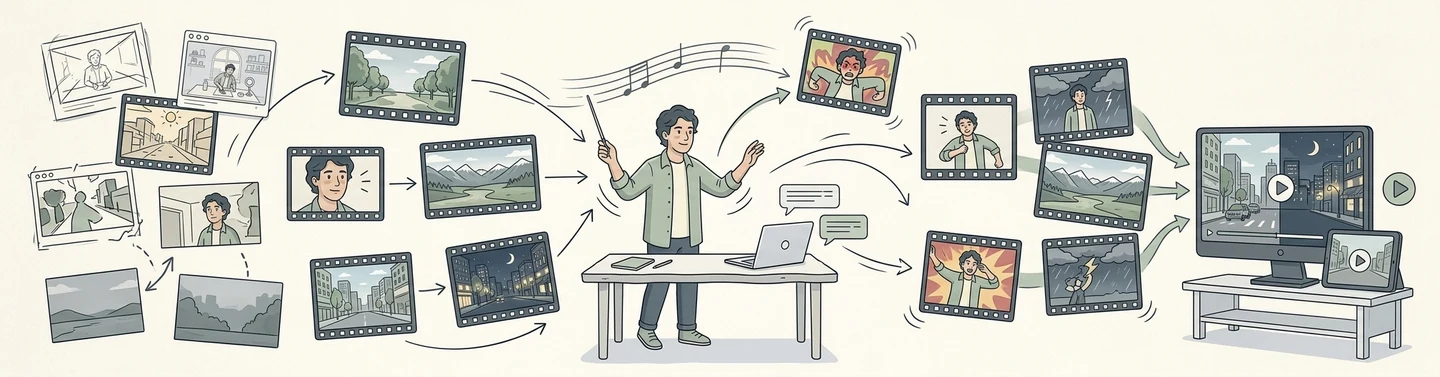
It is an explicit attempt to do for AI video what vibe coding did for software, and the phrase arrived attached to a launch, which is the usual way these things either stick or evaporate. Whether the words last is genuinely open. The workflow they point at, direction without a crew, is not going anywhere.
- Where it came from
- Vendor-coined. OpenArt, June 2026.
- Staying power
- Too early to call. Weeks old at the time of writing, one product behind it.
In a sentence
The whole spot was vibe directed in an afternoon, which is why the client will not pay for a shoot next time.
38.Synthetic users
Model-generated stand-ins for customers or research participants, used to simulate feedback, reactions or usability sessions. Hundreds of them answer immediately and cost almost nothing, which is the entire appeal.
The limit is not subtle. A model predicting what somebody might say is not a person meeting your product while distracted, sceptical, short of time or short of money, and those are precisely the conditions that produce the findings worth having. The credible use is narrower than the marketing: rehearsing an interview guide, pressure-testing a survey, or surfacing the obvious confusions before you spend real participants on them.
- Where it came from
- Breakout. Research-practice term, growing since 2023.
- Staying power
- Watch for hype. Real technique, routinely sold as a replacement for real research.
In a sentence
We ran it past synthetic users to catch the obvious confusions, then booked six real sessions.
39.Content Credentials
Cryptographically signed metadata attached to a file recording what captured or generated it and what has edited it since. Content Credentials is the reader-facing name for the C2PA standard underneath. Content Credentials
Camera manufacturers now sign at the moment of capture, editing tools preserve the chain, and several generative tools attach credentials to their output. Two forces are pushing adoption: regulation requiring machine-readable disclosure of AI-generated content, and platforms that would rather label than guess.
The honest limitation is that metadata can be stripped, so a missing credential proves nothing on its own. The standard establishes what is verifiably true about a file, not what is false about one without it.
- Where it came from
- Breakout. C2PA standard, reader-facing name in wide use through 2025 and 2026.
- Staying power
- Likely to last. Backed by regulation, hardware and platform labelling.
In a sentence
Check the Content Credentials before we run it. If the provenance has been stripped we treat it as unsourced.
40.Clanker
An insult for robots and AI systems, borrowed from Star Wars, where it is what soldiers call battle droids. It broke out of fandom in 2025 and is now aimed at delivery robots, support chatbots, automated phone systems and language models generally, and has picked up dictionary slang entries as a result. Merriam-Webster
Two things make it worth knowing rather than dismissing. It is the first widely used word for hostility toward AI as a category, which previously had no vocabulary at all, and that hostility is now a real commercial variable. Its spread also drew sustained criticism, because a large part of the online usage borrowed the grammar of racial slurs as a joke, which is a significant reason it travelled as fast as it did.
- Where it came from
- Revived. Science fiction slang, broke into general use in 2025.
- Staying power
- Idea lasts, name may not. Internet slang has a short half-life.
In a sentence
The support line put me through to a clanker and it took twenty minutes to reach a person.
Questions people ask about new tech terms
What are the newest tech terms in 2026?
The terms that broke out most recently are harness engineering, named by OpenAI in February 2026; agentic engineering, popularised by Andrej Karpathy in the same month; prompt debt, from Drew Breunig in June 2026; vibe design, from Google Labs in March 2026; vibe directing, from OpenArt in June 2026; and WebMCP, which entered a public Chrome origin trial in May 2026. Slightly older but still spreading fast are context rot, the lethal trifecta, slopsquatting, workslop, agent washing and Agent Skills.
What is the difference between vibe coding and agentic engineering?
Vibe coding means describing what you want and accepting the code without really reading it, which suits throwaway and personal projects. Agentic engineering means agents do a large share of the implementation while engineers keep the architecture, the constraints, the review and the verification. Karpathy put the distinction as vibe coding raising the floor of what anyone can build, and agentic engineering raising the ceiling of what professionals can ship.
Is vibe engineering the same thing as agentic engineering?
In practice they describe the same activity: disciplined professional software work in which AI agents do much of the typing. Simon Willison proposed vibe engineering in October 2025 and Karpathy popularised agentic engineering in February 2026. Neither has displaced the other yet, though agentic engineering has been picked up more widely by companies and tooling vendors.
What is the difference between prompt engineering and context engineering?
Prompt engineering is about the instruction you write. Context engineering is about everything in the model’s window at the moment it makes a decision, including system instructions, tool definitions, retrieved documents, earlier turns and notes the agent has written to itself. Anthropic describes it as curating and maintaining the best set of tokens during inference, which includes information arriving from outside the prompt entirely.
What is the difference between MCP and WebMCP?
MCP, the Model Context Protocol, is how an AI application connects to external tools and data sources such as a database, a file store or an internal service. WebMCP is a proposed web standard that lets an individual website declare its own actions so a browser-based agent can call them directly instead of guessing which button to click. They solve different problems and WebMCP is not a replacement for MCP.
What is query fan-out in Google AI Mode?
Query fan-out is Google’s own term for issuing several related searches from one question. Google’s documentation states that AI Overviews and AI Mode may use a query fan-out technique, issuing multiple related searches across subtopics and data sources to develop a response. For publishers it means a page competes to be useful evidence for branches of a question the reader never typed, not only for the phrase they did type.
Do I need an llms.txt file for AI search?
There is no evidence that it helps. Google’s Search Central guidance on AI features states that you do not need to create new machine readable files, AI text files, or markup to appear in AI Overviews or AI Mode, and no major AI provider has committed to reading llms.txt. The file is cheap to publish and harmless, so treat it as optional housekeeping rather than as a way to influence AI answers, and be sceptical of anyone selling it as one.
What does workslop mean at work?
Workslop is AI-generated work that looks polished but carries no real thinking, so the person receiving it has to do that thinking instead. The term comes from research by BetterUp Labs and Stanford’s Social Media Lab published in Harvard Business Review in September 2025. The practical test is whether effort was reduced or merely moved: if the sender saved ten minutes and the recipient spends thirty, nothing was gained.
What is the lethal trifecta in AI security?
The lethal trifecta, named by Simon Willison in June 2025, is an AI agent that has access to private data, exposure to untrusted content, and the ability to communicate externally, all at the same time. Any two are usually manageable. All three together mean text an attacker controls can instruct an agent that can read your data and send it somewhere else.
Which of these terms are just marketing?
Some are vendor-created language that describes something real: agent boss and Frontier Firm are Microsoft’s, service-as-software came from a venture capital firm, and vibe design and vibe directing were introduced with products. That does not make them empty, but it does mean the coiner has an interest in the term spreading. The entries most worth treating carefully are the ones measured loosely or predicted rather than observed: Share of Model, llms.txt, synthetic users and the one-person unicorn.
Will these AI buzzwords still be used in a few years?
Probably not all of them. Technology vocabulary is competitive and several names usually compete to describe the same change before one wins, which is exactly what vibe engineering and agentic engineering are doing now. The more reliable approach is to learn the underlying shift rather than to bet on a phrase, because the shift outlives whichever word ends up describing it.
What the vocabulary is telling us
There is a pattern in which words appeared when. The first wave of generative AI vocabulary was all about the model: prompts, tokens, context windows, hallucinations, benchmarks.
Almost nothing on this list is about the model. Harness engineering, context engineering, Agent Skills and eval-driven development describe the machinery around it. Agent sprawl, non-human identity, agent boss and service-as-software describe what happens when that machinery meets an organisation. Query fan-out, agentic search and Google Zero describe a discovery layer being rebuilt around it. Workslop, cognitive debt, slopsquatting and clanker are what people say when it goes wrong.
That outward movement is usually the sign of a technology leaving its own category and becoming general infrastructure. The vocabulary expands because people finally need names for problems that did not exist before, and those names arrive faster than any standards body can bless them.
Some of these words will be gone in three years. The behaviours they describe will not, which is the more useful thing to learn.